Posts

The Channel Tunnel - The World's Largest Undersea Tunnel

Image
  Introduction:- Now and then, with the advancement of technology, civil engineers have been creating marvels. One such commendable engineering wonder is the Channel Tunnel. The Channel Tunnel also referred to as the Eurotunnel or Chunnel, is a 50.45 km-long undersea rail tunnel below the Strait of Dover in the English Channel. It is one of the longest underwater rail tunnels in the world, connecting the Folkestone in Kent, the UK with Coquelles in Pas-de-Calais, France. This tunnel has cut travel times between the UK and mainland Europe dramatically. The tunnel's average depth is 50 meters below the seabed, and the lowest point 75 meters below. Started in 1887 and completed in 1994, the Eurotunnel is one of the most challenging civil engineering projects of the 20th century. It is regarded as one of the "Seven Wonders of the Modern World" by the American Society of Civil Engineers.     ...

Alumni Talks with Ms. Priyanka Padhy

Image
Getting into a government job, and that too via something as prestigious as OPSC Examinations undoubtedly takes constant efforts and perseverance. But figuring out the right direction towards this acme can be a lot painstaking.  We talked to Ms. Priyanka Padhy, a 2018 Civil Engineering graduate of NIT Rourkela, who has achieved meritorious results in the OPSC Assistant Executive Engineer (AEE) 2019 by emerging as the Girls Topper and has secured the laudable Rank 10. As an alumna of the institute, we believe, she can be the best person to guide the students who carry this aspiration in their hearts.  Following is an excerpt. CEST CLUB (CC) : Walk us through your childhood days. Ms. Priyanka Padhy (PP) : I have completed my 10th as well as 12th standard from Saraswati Sishu Vidya Mandir, Neelakantha Nagar, Berhampur, Odisha. I believe school life is the most important phase of life where one learns basic principles of behavior and etiquette. My school life nurtured me to develo...

Robotic Swarm Construction

Image
Introduction: The construction industry is different from other sectors because it involves more outdoor work and is more risk-oriented. Moreover, as it is labour-intensive, there is a need for safe construction. With the advances in robotics, robots can take over dangerous tasks. Swarm robots are one such invention. The idea here is to utilise simple robots to build a design without central guidance. They are a technological marvel that combines the benefits of robots with the power of large numbers. These robots have limited physical abilities and programming, and yet they do amazing things. Inspiration: Nature has always been an inspiration for many inventions. This is no exception. Think about an ant colony. Millions of insects work simultaneously to make a termite mound that includes features such as ventilation systems and humidity regulation in a short time. The distinctive quality here is that there is no leader giving instructions. Even if some insects wander off or...

Self-Sensing Concrete in Smart Structures

Introduction:- Concrete is one of the most widely used structural material used extensively in building various types of infrastructures. However, physical effects, including surface erosion, ageing, cracking, etc. and chemical products such as carbonation, sulphate attack leads to cement degeneration. Hence, to assess the health of the cement and avoid sudden accidents, Self-sensing Concrete is introduced. Self-sensing concrete (SSC) refers to a structural material that can monitor itself without the need of embedded, attached or remote sensors. By measuring the electrical resistance of the SSC, the stress, strain, crack, and damage can be monitored. Compared with conventional structural materials which require additional sensors for monitoring or detection, the SSC is advantageous in its high sensitivity, suitable mechanical property, biological compatibility, identical lifespan with concrete and easy installation and maintenance. Structure and Composition:- Self-sensing concrete has...

Microzonation of Earthquake Hazards

Introduction Many earthquakes in the past have left many lessons to be learned which are very essential to plan infrastructure and even to mitigate such calamities in the future. The hazards associated with earthquakes are referred to as seismic hazards. The practise of earthquake engineering involves the identification and mitigation of seismic hazards. Microzonation has generally been recognized as the most accepted tool in seismic hazard assessment and risk evaluation. It is defined as the zonation concerning ground-motion characteristics taking into account source and site conditions. Making improvements on the conventional macrozonation maps and regional hazard maps, the micro zonation of the ar region generates detailed maps that predict the hazard at much smaller scales. Seismic microzonation is the generic name for subdividing a region into individual areas having different potentials hazardous earthquake effects, defining their specific seismic behaviour for engineering design...

Intelligent Transportation System (ITS)

Image
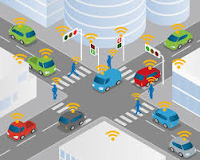
    Introduction ITS is an emerging transportation system which is comprised of an advanced information and telecommunications network for users, roads and vehicles. ITS is the integrated application of advanced Technologies using electronics, computers, communications, and advanced sensors. These applications provide travellers with important information while improving the safety and efficiency of the transportation system. Intelligent Transportation Technologies Wireless Communications: Dedicated Short-Range Communications (DSRC): It offers communication between the vehicle and the roadside in specific locations (ex- toll plazas). Continuous Air interface Long and Medium range: CALM provides continuous communications between a vehicle and the roadside using a variety of communication media, including cellular and infra-red links. Intelligent Transportation Applications (1) Electronic Toll Collection: Today, most toll roads are equipped with an electronic toll-collecti...

Preventable Nature of Crane Accident

Image
Need for Cranes and the Risks Involved  Cranes have become an essential part of equipment for the construction of buildings and structures, especially as the height increases. The huge loads required to be lifted, and the heights that they have to be carried to often makes such operations fraught with risk. This risk increases when the operators also have to contend with extreme wind and weather conditions that can increase the stresses on the cranes. Quite often, the crane operations are very much part of the critical path activities on project sites. Thus, accidents can cause serious loss of productivity and affect project schedules to a great extent. Because of the heights and sizes of such construction cranes, areas around the construction site can also be at risk, especially in populated areas. It is quite a standard practice for cranes to be designed and built for a particular project so that any peculiarities regarding area to be covered, heights, materials to be lifted and ...